Is the transition practical?
Assess comparable routes, fleet productivity, power capacity and total transport cost before defining a field pilot.
Explore the pilot pathway →
SIMSIM by CrystalAI · Carbon Intelligence
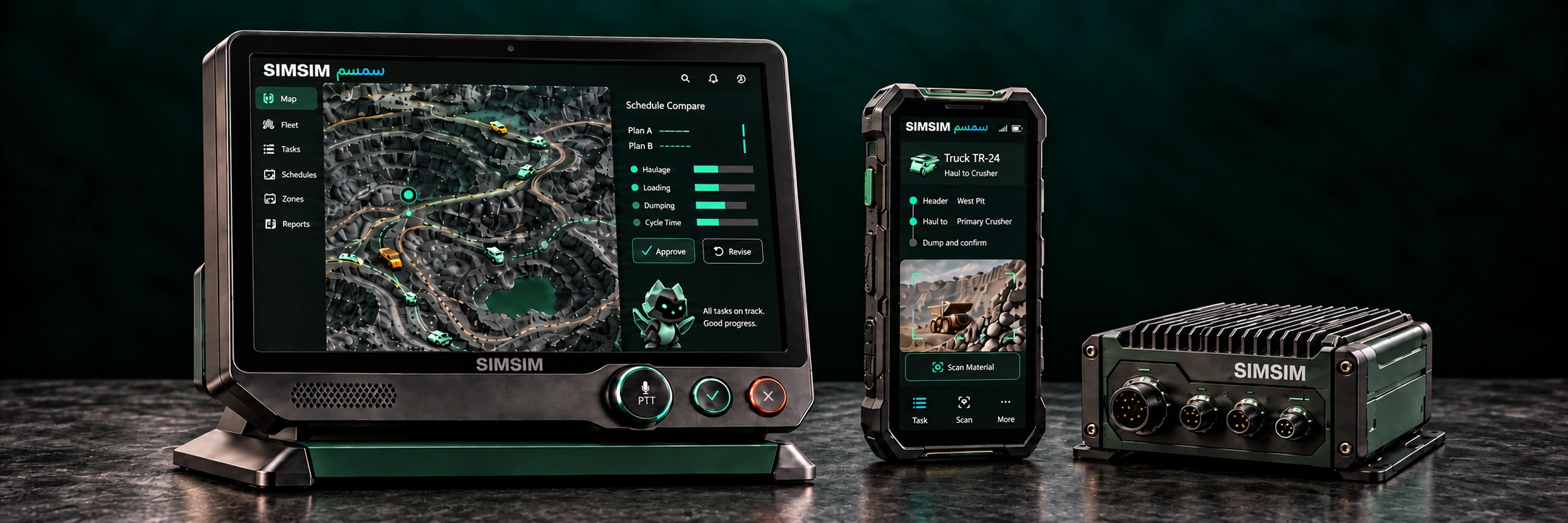
One platform concept for industrial operations, fleet electrification and traceable carbon data. Understand the work. Compare the energy. Review the evidence.
Product concept. All figures in the explorer are illustrative inputs, not site measurements.
Two tracks. One data foundation.
Assess comparable routes, fleet productivity, power capacity and total transport cost before defining a field pilot.
Explore the pilot pathway →Connect asset records and energy readings with a deterministic calculation engine, versioned factors and an evidence trail.
Explore the data foundation →The proposed platform in motion
A proposed connector records the machine, measurement period and fuel or electricity reading. No live source is connected in this illustration.
Interactive concept · No live data
Set the diesel and electric energy inputs for the same transport workload. See how your chosen factors affect the comparison.
Diesel CO₂ = litres × combustion factor.
Electric CO₂ = kWh × electricity factor.
Difference = diesel CO₂ − electric CO₂.
Intensity = CO₂ ÷ equivalent transport work.
Includes only the two selected operational CO₂ inputs. Excludes lifecycle emissions, other greenhouse gases, leakage and project eligibility tests. Not a corporate inventory, a verified project reduction or an issuable carbon credit. Location-based and market-based electricity reporting require separate factors and evidence.
Designed for traceability
Proposed inputs include vehicle systems, battery records, charging or swapping stations, meters and enterprise data.
Keep timestamped source records, asset IDs and factor versions alongside deterministic calculation runs.
Expose missing readings, estimation flags and review status before reporting or an operational action.
Corporate inventories, project reductions, lifecycle assessments and issued carbon assets have different rules. The proposed platform keeps them separate, with traceable mappings.
An assistant with the evidence in view.
SIMSIM is designed to orchestrate approved tools. Calculations come from defined rules; formal records and consequential actions remain subject to human review.
Use the Scenario Explorer above to enter matched transport work and energy inputs. Review the chosen factors and boundary before interpreting the difference.
No AI service or live connector is called by this website demonstration.
A conditional carbon market pathway
A measured operational improvement can support a project assessment. Carbon credits require a separate process: applicable rules, independent assessment and issuance in an authoritative registry.
Establish ownership of reductions, project boundaries, additionality and an applicable methodology. Check local rules and the intended use of any credits.
Document the baseline, comparable service, equipment categories and measurement plan. Retain calibrated meter records, energy sources, quality checks and versioned factors.
Prepare project documentation and obtain assessment by a suitably approved independent validation body. Complete the chosen programme’s registration process.
Submit monitored results for independent verification and programme review. Credits exist only when issued in the relevant registry, with serial numbers and a defined vintage.
Meet account, counterparty and market acceptance requirements. Reconcile credit ownership, registry transfers, contracts, delivery and payment records.
Record beneficiary, purpose, serial numbers and retirement evidence. Review the intended claim and applicable rules; prevent reuse or double counting.
Prepare traceable data and review workflows; link future registry, transfer and retirement records where authorised. Standards bodies, independent auditors and market infrastructure retain their separate roles.
No registry or exchange connection is live. CrystalAI does not issue credits or guarantee eligibility, price, sales or returns.
Planning checklist · stored only in this page
Mark the items you have documented. This checklist organises a discussion; it does not certify eligibility.
0 of 8 planning items marked. External assessment remains required.
Public examples of carbon-credit programmes and registries. Select a pathway only after checking the specific activity and current methodology requirements.
Verra registry reference ↗Gold Standard registry reference ↗Use the selected programme’s current list and the auditor’s specific sector approvals. Auditor qualification is separate from software capability.
Approved-body directory ↗Public examples of trading or credit-management infrastructure. Accepted credits, accounts, fees and delivery arrangements must be assessed separately.
VCM ↗ACX ↗Carbonplace ↗Independent reference organisations, not CrystalAI partners or integrated services. References reviewed 10 October 2026.
Verra VMR0014 is a relevant candidate for assessment of vehicle or mobile-machinery electrification. Its applicability, additionality, baseline and monitoring rules must be checked for each project. Tonne-km in the explorer is an operational comparison metric; it is not a substitute for a methodology’s prescribed units of service.
Corporate electricity reporting and project-crediting calculations follow different rules. Renewable electricity attributes require evidence and appropriate accounting; they do not by themselves establish a zero-carbon claim.
For Article 6 or CORSIA uses, assess host-country authorisation, corresponding-adjustment evidence and use-specific labels where required. These are not assumed requirements for every voluntary-market transaction.
Logistics · Mining · Ports
Explore fleet dispatch, quarry coordination and terminal haulage through three application videos. Simulated workflows are identified separately from supplied case footage; these videos do not establish independently verified performance results.
A proposed long-haul transport workflow connecting vehicle dispatch, charging and swapping, energy allocation and carbon evidence. Scenario for a large logistics operator in Western China. Operator identity is withheld.
30-second anonymised excerpt · Synthetic values · Concept demonstration
A proposed quarry workflow for shift planning, haulage coordination and response to operating constraints. This is a scenario demonstration, not a deployed customer project.
30-second anonymised excerpt · Synthetic values · No deployment or performance claim
A supplied port application video combining terminal imagery and an animated workflow: stockyard loading, weighing, quay delivery and cloud fleet coordination.
90-second supplied video · Footage and workflow visualisation · Results not independently verified
A pilot defined around the site
Confirm data access, comparable routes, equipment suitability and available power.
Build a diesel baseline and an electric scenario using agreed assumptions.
Validate production, transport cost, availability and traceable carbon data.
Expand after financial, equipment, infrastructure and evidence gates are met.
Equivalent transport work · Cost and energy per unit of work · Vehicle availability, replenishment and dispatch · Carbon data coverage and review readiness.
Targets and test periods are agreed with the customer. Carbon credit development is a separate, conditional pathway requiring rights, applicable methodology and independent assessment.